|
|
Forth Place: the Rail Ferries and the Buildings
Site navigation - please use menu on left (click here to display it if not visible). If problems, use site map.
|
Forth Place: the Rail Ferries and the Buildings Site navigation - please use menu on left (click here to display it if not visible). If problems, use site map. |
|
Please also see the page for 'Burntisland in 1883', which includes
photos of models |
On this page: Ferries Old Station Forth Hotel Downie's Stables
This article covers the history of the rail ferries and the three main buildings in Forth Place, Burntisland. Forth Place was the hub of the town's railway and ferry activity.
The railway came to Burntisland in 1847. From then until the opening of the Forth Bridge in 1890, Burntisland was a terminus of national significance. In that period, the Burntisland/Granton ferry was the principal means of crossing the Forth estuary. Passengers transferred from the train to the ferry, and back to the train at the other side. After 1890 the ferry diminished in importance, but Burntisland continued as a major coal exporting port for many years. There were hopes that Forth Place might recover some of its former importance when, around 2008, plans were being developed for a fast commuter ferry between Burntisland and Granton. The proposed 75 seater vessel would have crossed the Forth in a remarkable nine minutes. However the plans came to nothing when the company which was interested in operating the service withdrew.
With the publication in 2001 of 'Burntisland: Fife's Railway Port' by Peter Marshall, Burntisland's railway history has now been properly recorded for posterity. Peter's book runs to nearly 200 pages and contains more than 140 illustrations. It relates Burntisland's history as a major railway centre, as a ferry terminal and as a port - from the first arrival of the railway to the present day. It should be available from Stenlake Publishing (who now own Oakwood Press, the original publisher).
 |
Forth Place and
the surrounding area in 1901. The buildings marked 1, 2 and 3 comprise
Forth Place.
Key: 1
- Downie's Stables |
There was, until the 1990s, a wooden plaque (photo right) in Forth Place, commemorating the inauguration of the world's first roll on/roll off railway ferry in 1850. This was a rail ferry between Burntisland and Granton, with the fully loaded goods wagons being run directly onto and off the ship, as can be seen in the picture below. The picture is an engraving published in the Illustrated London News of 16 February 1850. It shows a train of wagons being pulled off the ship ar Granton. There is also an excellent description of the Burntisland/Granton rail ferries on the Granton History website.
|
|
THE FIRST RAILWAY STATION (1847)
The facade and principal offices of Burntisland's original railway station (pictured below) still dominate Forth Place. They date from 1847, when the Burntisland to Cupar section of the Edinburgh and Northern Railway opened. The Cupar to Ferry-Port-on-Craig section was opened the following year, completing the trans-Fife connection between the principal Forth and Tay ferries.
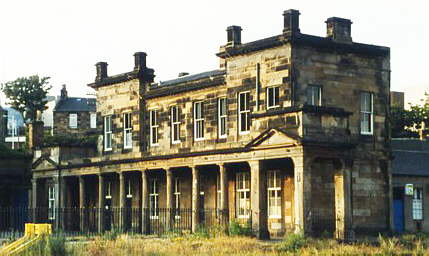 |
The 1847 railway station had a relatively short life span in its original manifestation as an important terminus. In 1890, on the opening of the Forth Bridge, it was replaced by a decidedly modest and undistinguished through station on the adjoining site to the north. That station still serves the town. With the possibility of a replacement to the east having been debated and rejected some years ago, it will be with us for the foreseeable future.
William Erskine, in his 'Glimpses of Modern Burntisland' (Fifeshire Advertiser, 1930), commented on the fate of the original station buildings at the time he was writing:
"The erection of the station buildings introduced variety into the architecture of the vicinity. ...
The station itself was much the same as it still is, the polished stone portico with its weather-worn pillars forming the western front. Otherwise it was innocent of any pretension to elegance, the projectors of it having designed the buildings for utility rather than as a model of aesthetic taste. The old ticket or booking-office is now utilised as a dwelling-place for railway servants, and, of course, the span of the station roof has gone the way of most earthly things. The row of low buildings formerly used for miscellaneous purposes still remains, neglected and pointless, a testimony to the economical tendencies of railway management. Even the good old 'Bar', which resounded often with the desperate cries of thirsty and semi-famishing travellers, and where sweet and attractive young ladies supplied the demand, has lost its virtue, and may now be the home of the rodents, upon whose heads or tails hygienic authorities have set a price. A foreign mission station occupies an adjoining room, and it is understood that the space therein provides ample accommodation for all that maybe attracted to it."
In the 1990s, the original station building housed Forth Ports' offices, and in the old platform buildings to the rear was a licensed railwaymen's club. More recently they were all converted to business units, with their outer walls and features being repaired and retained. The photograph below shows Forth Place in March 2017. Left to right are - Downie's Stables; the modern apartment block on the Forth Hotel site; the converted main station building; the converted platform buildings.
|
|
|
Burntisland featured in the Tay Bridge disaster of 1879. The train which was lost on 28 December of that year was the 5.27pm service from Burntisland to Dundee Tay Bridge station. And thanks to Ewan Walker, we know that James Smith, one of his ancestors and a man with Burntisland connections, found himself playing a major role in the immediate aftermath of the disaster. Born in 1831, James Smith (pictured right at the
time of his retirement in 1901) began his railway career as a porter.
By 1861 he had risen to the rank of Stationmaster and was in charge of
Burntisland station. He and his wife lived in accommodation on the
upper floor of the main station building. In November 1866, his
apartment was one of the areas of the building destroyed by a major
fire. Luckily no-one was injured. When James left Burntisland in
1874, he was presented
with a In 1874 he became Stationmaster at Polmont. When Dundee's Tay Bridge station opened in 1878, he was appointed its first Stationmaster.The bridge itself opened on 1 June 1878. Peter Marshall, in his 2001 book "Burntisland: Fife's Railway Port" tells us that, on 28 December 1979 "..... driver David Mitchell and fireman John Marshall set forth [from Burntisland] at 5.27pm on the footplate of the green Wheatley. The train kept good time, even more necessary with 14 scheduled stops before Dundee and a howling gale blowing. Only a little late at Thornton, the train was at Leuchars by 7.00pm only a few miles from home. At the final stop, St Fort, the tickets were collected from the passengers before they set off over the bridge ....." The train was expected in Dundee shortly after 7.20pm. Those awaiting its arrival, including Stationmaster James Smith, became increasingly concerned when it did not arrive. They had been informed by the signalman on the other side that the train had passed onto the bridge, but the violent storm and the darkness meant that they could not see what had happened to it. James Smith and his colleague, locomotive foreman James Roberts, decided to go out onto the bridge to investigate. From John Prebble ("The High Girders", 1956): "They went out together, moving quickly at first along the bend through the bowstring girder, and the wind was not too strong and Smith had no fear. But once they reached the end of the bend the wind was like a falling wall of wool, pressing them down to their knees, to their bellies. ..... [Roberts] crawled on until, in another interval of moonlight, he saw that there was suddenly nothing left of the bridge for him to crawl upon. Ahead of him stretched a great gap, and below it twelve great tufts of white spray where the river snarled at the broken piers." Both men returned safely and were able to confirm everyone's worst fear, that the central section of the bridge had collapsed, taking the train with it. From Peter Marshall: "The telegram, sent by station master James Smith of Dundee Tay Bridge station to the North British headquarters in Edinburgh, has entered the annals of railway history: Terrible accident on the bridge. James Smith began his well-deserved retirement in 1901 after 50 years of service. |
This building had a long and distinguished history. Its demolition in 1997 became inevitable after a period of shameful neglect. The Forth Hotel joined a long list of historic buildings, the loss of which have demonstrated the inability of the authorities to protect our built heritage. The fact that the Forth Hotel was listed by the Government agency, Historic Scotland, as being of special architectural/historic interest made no difference.
The original building on the Forth Hotel site was the parish manse, built about 1823-24. It was an early work by the prolific architect, William Burn (1789-1870). Burn specialised in country houses, designing about 150 in total, including Falkland House, Balcarres House, Balintore Castle and Tynninghame.
The prospect of the arrival of the railway made the manse an attractive option for the railway company, who bought it from the Church of Scotland. Around 1843-47 it was extended and converted into the Forth Hotel, a project which was planned and supervised by the architect John Henderson. Henderson was a busy man in Burntisland at that time, for he also was the architect for the Burgh Chambers (1845-46). The Church of Scotland built a new manse in Cromwell Road (now Links View Care Home).
|
|
|
|
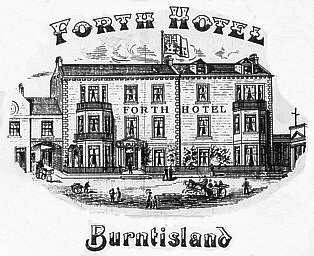
The hotel around 1900, from a contemporary drawing ..... |
..... and photographed in 1989, eight years before demolition. |
William Erskine had this to say about the Forth Hotel:
"The main structure there was the old Manse, which is still the central part of what has now become the headquarters of the local officials. The Manse, however, had lost the peacefulness it had formerly enjoyed, and, repose having departed, the heritors had to find the minister a new home in Cromwell Road, where it still exists. ...
Out in the open square, the old Manse had additions annexed to it, and these, with the original centre, formed what for many years was 'The Forth Hotel'. As such, it had a great reputation, which it is believed brought to its lessees a competency, if not a fortune. The Clarks and the McJanets were among the early 'hosts', but the hey-day of its prosperity was that when the genial, ever-smiling Mrs Horsburgh reigned as queen. In her time, 'The Forth' was a name to conjure with. The 'swells' of the town made it their rendezvous and 'commercials' made it their lodging, because of its comforts and its proximity to the station. Even the heads of the then prosperous colliery companies rented a room where important business was done, and legal gentlemen acting as factors for certain house proprietors gathered in their rents: and 'tax-gatherers', in their season, collected from unwilling taxpayers what Governments considered their due. Even the late Sir George Campbell, M.P., was known to patronise the 'Forth' to find inspiration for his infrequent but lengthy speeches to the electors. And in the inner recesses of the 'Forth' there existed a 'taproom', with an entrance to it from the pend, because while Mrs Horsburgh made every caller welcome, she preferred to keep certain customers apart. How many private assignations met their fruition there is secret history, but were afterwards confirmed by several 'pretty weddings' which took place in the nicely-furnished 'upper-room'.
With Mrs Horsburgh's relinquishment of the establishment, after the ferry was shorn of its glory, the 'Forth' met in with 'slack water'. Various lessees ventured to maintain its name, among them Mr McLean and Mr Louden, but it became a fight against fate. Rent and taxes, together with licence duties, swallowed much of the profits, and the place gradually ceased to be."
At the time of the Coronation of Edward VII in 1902, the Forth Hotel was described as "the best decorated building in Burntisland". Ann McCall (see below) remembered years later that the hotel was "a riot of colour: red, white and blue, all entwined around the door pillars".
The last proprietor of the Forth Hotel was the colourful character, James Louden. Born in Hillend in 1848, he started his working life as a ship's carpenter. He became a railway engineer, working in Sri Lanka and Trinidad. He was involved in the construction of the Forth Bridge, almost losing his life in an accident just before its opening in 1890. He also worked on Tower Bridge in London, which opened in 1894.
Retiring from engineering, he took over the Forth Hotel in Burntisland in 1903 and ran it until his death in 1914. His niece, Ann McCall (also the proprietor of The Green Tree Tavern in the High Street), took over until the lease expired in 1917. The building then reverted to the North British Railway Company.
 |
 |
|
James Louden |
Ann McCall with her daughter and father |
Around 1920, the Forth Hotel was converted to the Burntisland railway Control, which is how the building is best remembered in the town today. It controlled train movements in an area stretching to Bridge of Earn and Montrose to the north and Causewayhead (near Stirling) to the west, and southbound trains as far as the Forth Bridge. It eventually became British Rail's District Operating Administrative Office, although to local folk it remained simply 'The Control'.
In 1965 the superintendents, clerks and typists were relocated to Edinburgh, and complete closure followed five years later. Very precisely, at 10.00 p.m. on Sunday 1 February 1970, the Burntisland Control ceased to be - as did equivalent operational centres at Aberdeen and Edinburgh Waverley, all subsumed in the new Edinburgh Waverley Communications Centre.
The building was put on a care and maintenance basis, looked after by the local station staff. In due course it was sold to a building company. Plans were put forward to convert it to flats, but they came to nothing. The fabric was now deteriorating rapidly, and in 1993 the local authority suggested that the site be used for a 'park and ride' facility - this also came to nothing. By 1997 the old hotel had decayed to such an extent that it had to be demolished. A new block of flats was recently erected on the site.
This is the western building in Forth Place. It was constructed in 1845 to provide accommodation for employees on the Burntisland/Granton ferry. The adjoining row of properties round the corner in Harbour Place were built at the same time and for the same purpose.
 |
|
|
On the left: the front of "Downie's stables". On the right: a very old photograph, probably from the 1850s, of Archibald Downie (1835-1895, and brother of Andrew Downie referred to by Erskine below; photo courtesy of Jill Martin of South Africa, his great granddaughter). |
|
Quoting William Erskine again:
"The western section of this building [more correctly, the building adjoining the Forth Hotel to the west] for many years was used as an hostelry, and almost from the opening of the ferry was maintained by Mr [Andrew] Downie (and latterly by his son Alec), with varied fortune. In the pre-motor days, 'Downie's stables' were as well-known as the 'Forth'. Trippers hired waggonettes for a day's outing, and private parties engaged the smaller vehicles for a family airing. Travellers visited their distant customers in a gig, and belated-ones sought their way home by having a machine. Hires to Aberdour, which then was railway-less, were frequent, and the stabling of contractors' horses added to the value of the business. But, with the advent of the motor, and, later, with the coming of the 'bus, users of the road abandoned special hiring, the old-time hostelry occupation sagged, and stables have been superseded by the garage. 'Sic transit gloria mundi.' "
Webpage by Iain Sommerville;
Help
on bookmarking this page.


 gold
watch, pictured right, which was inscribed "Presented
to Mr Jas Smith along with a purse of sovereigns by a number of friends
on his leaving Burntisland May 1874".
gold
watch, pictured right, which was inscribed "Presented
to Mr Jas Smith along with a purse of sovereigns by a number of friends
on his leaving Burntisland May 1874".